
Douglas County Parole and Probation
Probation, parole, and post-prison supervision all place rules on a person living outside a jail or prison, but they start in different ways. Douglas County Community Corrections performs local field supervision. The Oregon Board of Parole and Post-Prison Supervision sets conditions for people leaving prison on parole or post-prison supervision. A Douglas County court judgment is the key source when probation follows a local criminal case.
That split determines where to verify a record. Court probation should be traced from the judgment and case register to the local office. Parole for a case within the Board's release authority should be traced through a Final Board Action and the supervising office. Post-prison supervision, often shortened to PPS, follows many determinate Oregon prison sentences. It is not the same as parole even though the Board sets conditions for both.
| Supervision type | How it begins | Best verification sources |
|---|---|---|
| Probation | A court judgment orders community supervision, which may occur without a state-prison term. | Douglas court judgment, case register, and Douglas County Community Corrections. |
| Parole | The Board authorizes release for a person in a category still governed by parole law. | Final Board Action, VISOR or OOS within their scope, and the local supervising office. |
| Post-prison supervision | A supervision term follows many determinate Oregon prison sentences. | Judgment or ODOC record, Board conditions, and Douglas County Community Corrections. |
- Parole
- Conditional release from prison under Board authority for a case governed by parole law.
- Probation
- Court-ordered supervision in the community, often tied to a county criminal judgment.
- Post-prison supervision
- The supervision term that follows many Oregon determinate prison sentences.
- Discharge
- The documented end of the relevant supervision obligation, not merely release from a jail.
- Absconder
- A person alleged to have stopped reporting or left supervision without authorization.
Verify Douglas County Post-Release Supervision
Start with the event that placed the person under legal control. The Douglas Jail Viewer can confirm that a county booking ended, but it does not by itself prove whether probation, parole, or PPS followed. A Douglas Circuit Court judgment identifies probation and sentence terms. An Oregon Offender Search record connects a state-prison sentence to release status. A Board Action Form records a Board decision when Board jurisdiction applies.
- Match the Douglas County booking or court case by booking number, case number, name, and date. Read the judgment if probation may have been ordered.
- Check Oregon Offender Search and VISOR by SID when known, or by a carefully matched name. Each tool has limits, so do not rely on name alone.
- If a Board decision applies, obtain the Final Board Action by name, SID, and hearing date. Read its decision, release date, next action, and PPS-expiration fields.
- Call Douglas County Community Corrections with a focused question and the available SID or case number. Staff may limit what can lawfully be disclosed.
- Keep the court, ODOC, Board, and local supervision records separate. One office cannot certify another agency's event.
The county release search and record chain are covered on the Douglas County released inmates home page. Use that route when the first question is whether a jail booking actually ended, then use the supervision sources above.
Note: A person can leave physical custody while probation, parole, post-prison supervision, a warrant, or another agency hold still remains active.
Douglas County Supervision Office
Douglas County differs from most Oregon counties because the Oregon Department of Corrections directly operates its Community Corrections program. The office coordinates with courts, jails, and prisons while supervising adults on probation, parole, and PPS. It is the practical local contact after the judgment or state record has established the likely form of supervision.
Douglas County Community Corrections
1036 SE Douglas Avenue, JB206
Roseburg, OR 97470
Phone: 541-957-8148
Fax: 541-957-8149
Monday through Friday, 8 a.m. to 5 p.m.
The official ODOC office profile shows the local contact and direct state operation. The screenshot below captures that source as it appeared during research.
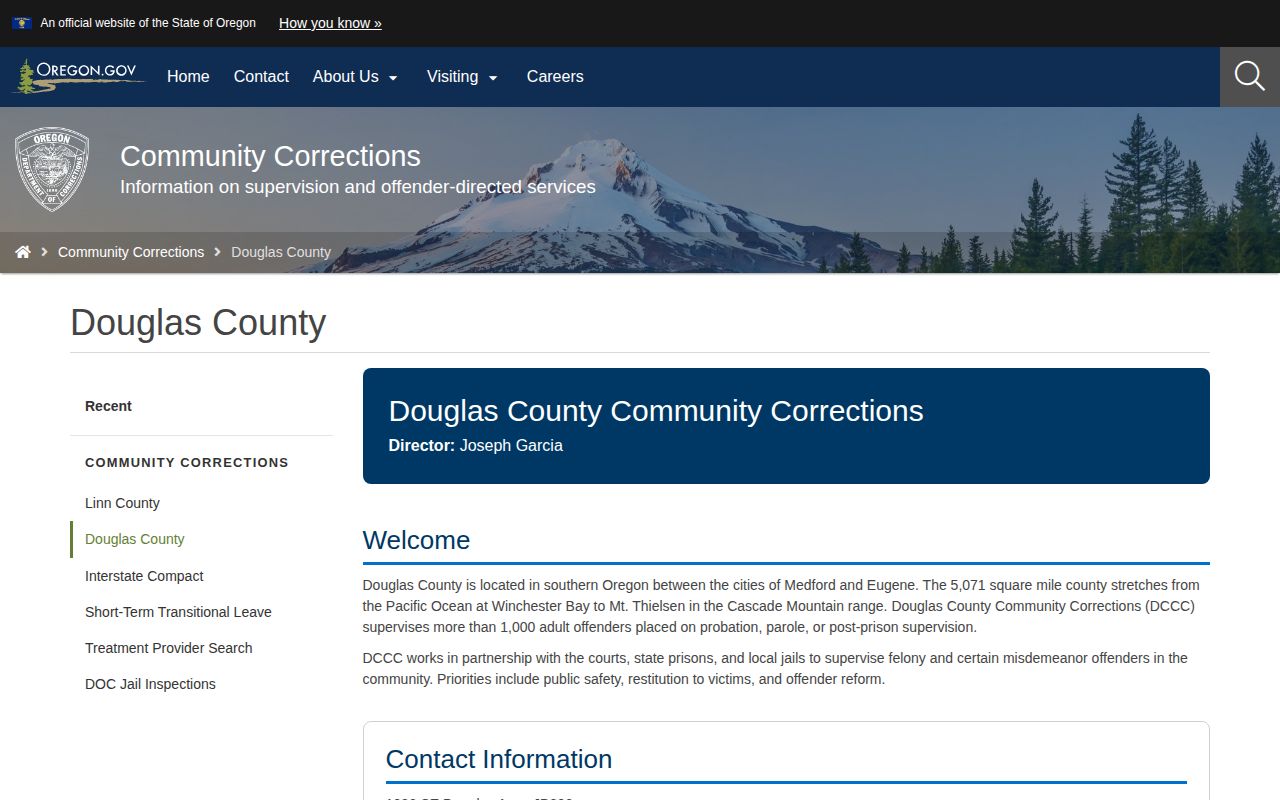
The office listing helps route supervision questions, but a phone response does not replace a judgment, ODOC record, or Final Board Action.
Douglas County Supervision Scale
ODOC reports that Douglas County Community Corrections supervises more than 1,000 adults across probation, parole, and post-prison supervision. This is not a jail population count. It describes active community-corrections cases handled by the state-operated local office and shows why a person may remain under legal control well after a Douglas County Jail booking closes.
Direct ODOC operation also affects routing. Questions about a local jail release belong to the Douglas County Sheriff's Office. Questions about the judgment belong to Douglas Circuit Court. Questions about current field supervision go to Community Corrections. Board release authority and Board-set conditions belong to BOPPPS. Those offices share parts of a person's timeline, but none owns the whole record.
Note: Use a SID or court case number when possible because identical names can refer to different Douglas County supervision records.
Douglas County Parole Hearing Records
Most Oregon offenses committed after November 1, 1989 carry determinate sentences, so the Board does not hold a release hearing for most modern prison terms. It still sets PPS conditions. Release-hearing authority remains for defined groups, including certain older cases, dangerous-offender cases, aggravated murder, and qualifying murder sentences. There is no sound one-step formula for first eligibility. The offense date, judgment, and governing law control.
The Board's inmate hearing page and calendar list scheduled proceedings. Since May 7, 2025, hearings have been held in person inside Oregon State Penitentiary or Oregon State Correctional Institution, with the location stated in each notice. Public attendance requires advance visitor approval. The calendar has no stated fixed posting cycle, and it should not be confused with Board business meetings.
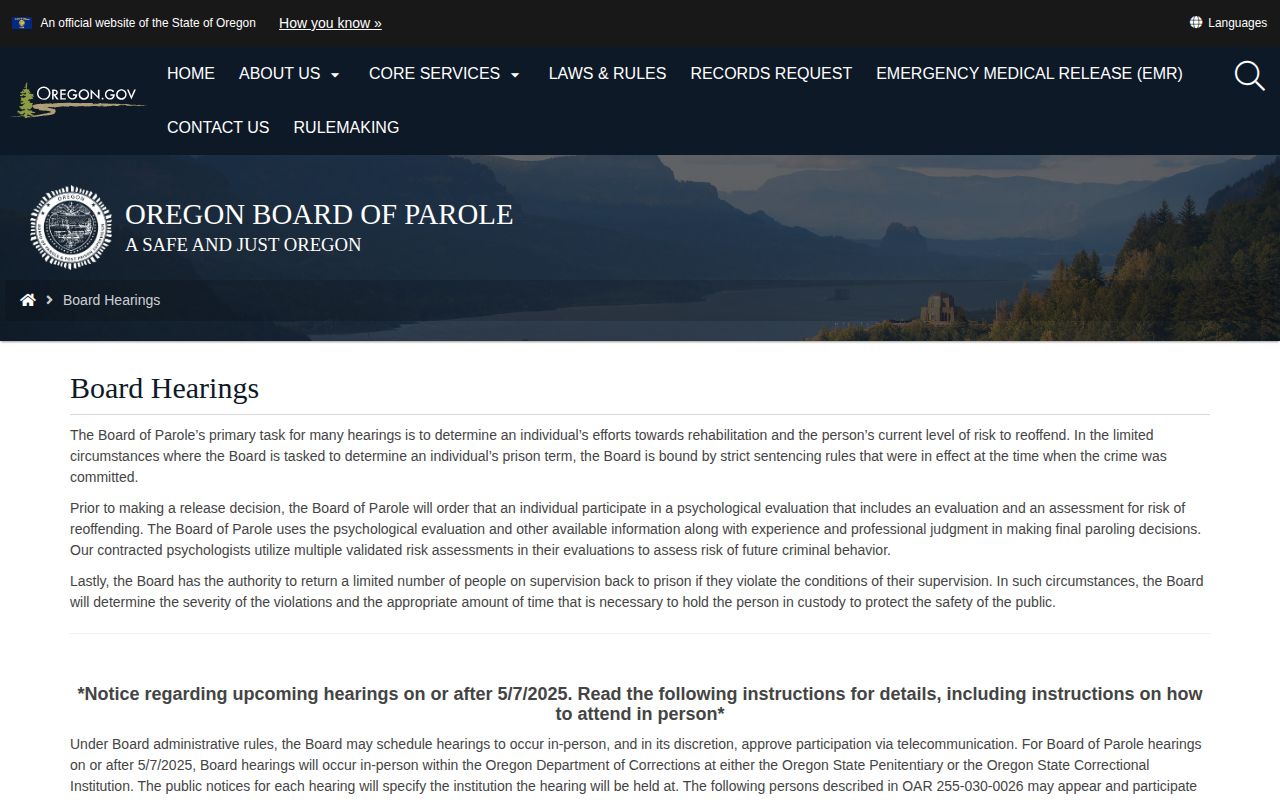
The captured calendar confirms the official schedule channel. For attendance approval or schedule questions, contact the hearings specialist at 971-718-6163 or BPPPS.Webmaster@paroleboard.oregon.gov.
Board action names matter. A Prison Term hearing may set or decline to set a projected parole date. Parole Consideration may set a date or, if release is denied, commonly set another hearing in two years. An Exit Interview may affirm or defer a projected release date. Future Disposition after revocation decides whether to rerelease a person or continue imprisonment. ORS 144.120 governs the initial parole-hearing procedure, while murder eligibility can involve ORS 163.105, 163.107, and 163.115.
Douglas County Board Action Proof
There is no verified public name-based database of Oregon Board decisions. The durable artifact is the Final Board Action, also called the Board Action Form. Its official Board Action Form key identifies fields for the hearing or action date, decision, parole release date, next action, and post-prison-supervision expiration, among other coded entries.
Request an individual action from BOPPPS at 1321 Tandem Avenue NE, Salem, OR 97301, or call 503-945-0900. Give the person's full name, SID, and hearing date if known. A court judgment may explain the sentence, while the Board form proves the Board's own action. Under Oregon Public Records Law, an agency may clarify a request, estimate actual cost, require payment, and redact exempt fields. The five-business-day provision in ORS 192.324 concerns acknowledgment or completion, not a guaranteed production date.
Douglas County Supervision Violations
A supervision violation can lead to changed conditions, local sanctions, jail detention, or a return-to-custody process. Those are distinct events. A Douglas County Jail record can show a new booking, while the court or Board record explains the legal response. VISOR may report a custody or supervision change, but it is a notification and public-information service rather than a certified status document.
No complete official Douglas County absconder list was found. ODOC's statewide Corrections Most Wanted feature is selective, so absence from it proves neither compliance nor discharge. A warrant question should be checked through the court and current custody sources, then addressed with Community Corrections. The Oregon sex-offender registry is narrower still. It applies only to people with a registration duty and public display depends on notification level, so it is not a general parole or probation search.
Note: A selective wanted list or registry cannot stand in for the full Douglas County supervision record.
Douglas County Release Planning
Douglas County's IMPACTS program documents a local transition route linked to jail discharge planning. Its work includes jail in-reach, transportation, DMV assistance, and care coordination through county and community partners. The program is a navigation and planning resource. It does not certify release, supervision type, or the end of a sentence.
This distinction helps when a person is preparing to leave custody. Release logistics can be coordinated while supervision remains active. The jail records the custody exit, a court or Board record sets legal terms, and Community Corrections handles field supervision. IMPACTS can assist with parts of the transition, but it should not be treated as a public status-search office.
Douglas County Release-Day Support
A 2025 Douglas County treatment-court report documents one planned 7 a.m. release. Clothing had been placed with the person's property, food was arranged for a long trip, and medical transportation was coordinated. That account is a specific case example, not a countywide promise about release time, property, meals, or transportation.
State-prison release follows a separate rule. ORS 421.125 addresses suitable clothing and the person's money and documents when ODOC discharges or paroles someone. It does not convert a Douglas County Jail example into general ODOC policy. For any planned release, confirm current details with the agency that holds the person and keep those logistics separate from proof that supervision ended.
Douglas County Supervision Discharge
Supervision ends through an agency or court action, not through silence in an online tool. For probation, read the court record and any discharge or termination order. For parole or PPS, obtain the relevant ODOC or Board record. A Final Board Action may show the PPS-expiration field, but the individual document and later actions still control.
VISOR can return no result when a person is fully discharged and no longer supervised. The same blank result could also reflect a spelling problem, delayed feed, offline jail, or a record outside the service's scope. Confirm the person's identity, preserve the case or SID number, and request the source record when the exact end date matters. That chain distinguishes release from custody, active community supervision, and final discharge.