
Douglas Projected Versus Actual Release
A projected release date, often shortened to PRD in Oregon corrections material, is the agency's current forecast. It is based on the judgment, sentence start, credited time, controlling law, and any credits for which the person is eligible. The date can move. By contrast, an actual release date records an event that the jail or prison reports as having occurred. Douglas County Jail Viewer separates these ideas with an actual Release Date and a scheduled Sch Rel Date. A scheduled field alone does not prove that the person left custody.
Pretrial detention is different. A person awaiting trial usually has no fixed sentence-end date. Release may depend on bail, a conditional-release order, dismissal, a plea, or another court ruling. Even after a local court authorizes release, another warrant or detainer can cause transport to a different custodian. A detainer is a request or legal basis for another agency to take custody. Douglas County records must therefore be read with the clearance reason and court case, not as a stand-alone date.
Find a Douglas Projected Release Date
The right lookup depends on who owns the sentence. Douglas County Jail holds pretrial adults, people serving county terms of up to one year, and people waiting for transport after an Oregon Department of Corrections commitment. ODOC records control the prison calculation after intake. A county booking date that ends in TRANSPORT marks the end of local custody, not the final prison release.
- Start with the Douglas County Jail Viewer advanced query. Search by name and open the matching booking rather than relying on the current roster.
- Compare the actual Release Date, scheduled release date, clearance reason, sentence-end information, court number, and any transport notation. Match the booking number carefully because one person may have more than one booking.
- For an ODOC commitment, search the Oregon Offender Search by SID when possible. The official system requires acceptance of its disclaimer, and its public release information can change after recalculation.
- Read the court judgment through Oregon Judicial Case Information Network resources. The judgment establishes the sentence, while the custodial agency computes and records its projected date.
- If the public display is missing or unclear, request the booking record from DCSO or an official offender record from ODOC Public Records. Ask for the calculation or status document, not a guess.
The full Douglas County released-inmate search path also distinguishes court, federal, immigration, and local jail records. Use it when the holding agency is uncertain. A federal sentence belongs in the BOP locator, while ICE's locator addresses current immigration detention rather than a county sentence.
The live Oregon Offender Search interface shows the public-service disclaimer before access.
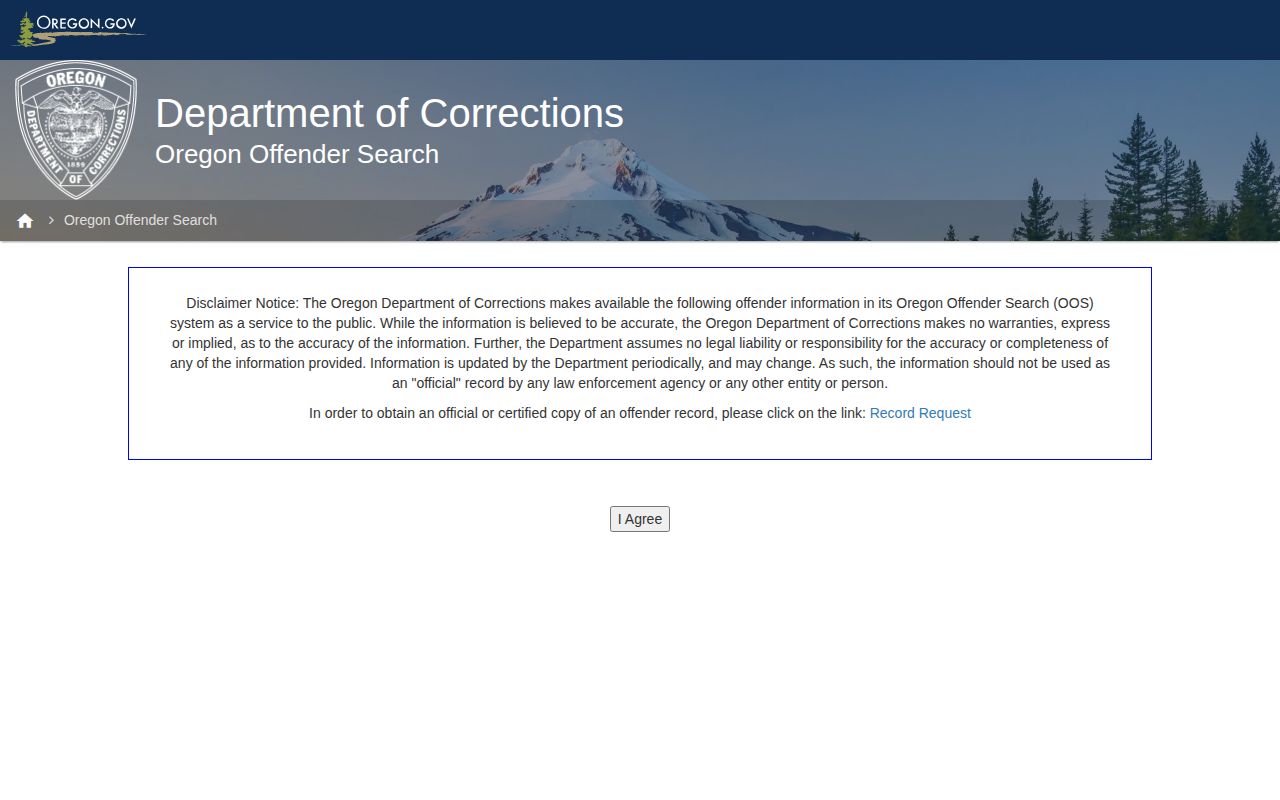
This screen is the correct state starting point after a Douglas County booking becomes an ODOC prison record. The research did not verify a stable released-person result screen, so no exact label or field is promised here.
Oregon Credits Shape Douglas Release Dates
ORS 421.121 is Oregon's central earned-time law for eligible felony sentences tied to crimes committed on or after November 1, 1989. It permits a reduction for suitable conduct and participation in adult basic-skills development. The maximum reduction is 20 percent of the incarceration term, and the credit cannot reduce actual prison confinement below six months. Credits may be granted, retracted, and restored under agency rules. Eligibility turns on the offense, offense date, and law that governs the judgment.
Oregon does not use a blanket rule that everyone serves 85 percent. An eligible ordinary sentence with the full 20-percent credit could imply service of 80 percent, but the award is not automatic. Measure 11 mandatory minimums under ORS 137.700 generally cannot be reduced through ORS 421.121. Limited sentencing exceptions under ORS 137.712 depend on specified offenses, findings, and the court's judgment. They are not discretionary jail good time.
Sentence calculation also depends on whether terms run together or one after another, the amount of custody credit, any amended judgment, and the legal rules effective for the case. Consecutive terms run in sequence. Concurrent terms overlap. A court establishes those parts of the sentence; ODOC applies the controlling law and credits. For a named person, request the agency computation rather than doing legal arithmetic from a docket.
Note: Eligibility for earned time is individual, so the maximum percentage must never be presented as a guaranteed Douglas County release reduction.
Why Douglas Release Dates Change
A PRD is recalculated when new legal or agency facts enter the record. VISOR has warned that an Oregon Supreme Court ruling changed some sentence calculations and that registered users may receive notices when a PRD changes. That is a useful alert, but the agency record still controls. Changes do not all have the same effect. Some alter the sentence computation, while others change only where the person goes when one custodian releases them.
| Factor | Possible effect on the Douglas release date | Best confirmation |
|---|---|---|
| Earned time | Eligible credits may be granted, withdrawn, or restored. | ODOC computation or status record |
| Court amendment | A corrected judgment or custody-credit ruling can change the base calculation. | Court judgment plus ODOC update |
| Discipline | Loss or restoration of eligible credit may move the forecast. | ODOC sentence record |
| Board action | For limited legacy or indeterminate cases, a Board decision may set or defer parole timing. | Final Board Action |
| Detainer or warrant | ODOC or DCSO may end custody, but another authority can immediately receive the person. | Release record and receiving agency |
| Transitional leave | Physical placement can change before the prison term's projected end without ending the sentence. | ODOC status and supervision instructions |
Short-Term Transitional Leave under ORS 421.168 and OAR 291-063 may move an eligible person from physical prison custody before the prison date. ODOC materials describe possible 30-, 60-, 90-, or 120-day placements, subject to approval and eligibility. That status is not sentence discharge. The record should say whether the person remains under correctional control.
Douglas Jail Dates Need Local Proof
A county jail sentence should not be calculated with the ODOC felony earned-time statute by default. The Douglas research found no published general county-jail good-time formula and no universal weekend or holiday early-release policy. Jail Viewer may show a scheduled date, sentence-end information, and an actual release. DCSO Corrections can clarify the operational record, while the Douglas Circuit Court judgment supplies the sentence and credited-time basis.
The same caution applies to release time and exit logistics. No official universal hour, public waiting point, or transit handoff rule was found. A treatment-court report documents one planned release at 7 a.m. with clothing, food, and medical transportation. That is one sourced case, not a standing schedule. Call the Douglas County Jail information line for current arrangements rather than applying that example to another person.
Transport makes the local date especially easy to misread. DCSO says an adult with an ODOC sentence longer than twelve months and no pending charges is taken to the state intake center at Coffee Creek. Another Oregon county may also receive a person on its warrant after Douglas matters resolve. In both cases, the person was released from Douglas County Jail but not released to the community.
A recent local booking can also involve several dates at once. Booking date marks admission. A court's next-event date marks a hearing, not an exit. Sentence-end information supports the calculation, while the scheduled release field records an expectation. Only the actual release field states that Douglas County ended that booking's custody. Read each label before calling the jail, and use the booking and case numbers so staff can distinguish one episode from another.
Douglas Board Release Timing
The Oregon Board of Parole and Post-Prison Supervision does not decide the prison release date for most modern Oregon sentences. Its official explanation says most people whose crimes occurred after November 1, 1989 received determinate terms. A determinate sentence has a length fixed under the judgment and governing law. The Board still sets post-prison-supervision conditions, but it generally does not grant or deny the end of that prison term.
Board release authority remains for defined groups, including certain older parole-law cases, dangerous-offender cases, aggravated murder, and qualifying murder sentences. For those records, use the official Board hearings calendar to identify a hearing, then request the Final Board Action. The form can state the decision, parole release date, next action, and supervision expiration. There is no verified public name-based Board decision database.
A hearing outcome can affirm a projected date, defer it, set another review, or take another action allowed for that case type. Eligibility must come from the offense date, judgment, and governing statute. It should never be inferred from a general web result or from the mere presence of a person on the Board calendar.
Confirm a Douglas Release Event
Use an event source for final confirmation. Oregon's current notification service is VISOR, which replaced the older VINE and VINELink-facing workflow. It can send custody, transfer, release, escape, death, and PRD-change notices for participating Oregon county and state feeds. The Douglas County VINELink inmate search instructions explain the current VISOR process. A person who is fully discharged and no longer supervised may not remain searchable.
For a local booking, pair the Jail Viewer actual date with its clearance reason. For prison release, preserve the ODOC or VISOR event and request an official record if formal proof is needed. For a Board-governed case, obtain the Final Board Action, which can record the decision, parole release date, next action, and post-prison-supervision expiration. Most modern Oregon determinate sentences do not receive a Board release hearing.
Douglas County Community Corrections may supervise probation, parole, or post-prison supervision after physical release. Supervision is legal control in the community and has its own end date. It should not be confused with the day a jail or prison gate event occurs. The court judgment supports probation terms, while a Board Action can support parole or post-prison conditions. Douglas County Community Corrections can answer permissible status questions, but there is no complete public name-based local supervision search.
- Projected release date
- The agency's current forecast, subject to lawful recalculation.
- Actual release
- The recorded event when a custodian ends its physical custody.
- Discharge
- The end of the relevant sentence or supervision obligation.
- Detainer
- A basis for another authority to receive or continue custody.
One date cannot answer every custody question. Confirm the custodian, the event type, and any supervision that follows. That three-part check prevents a transfer, leave placement, or scheduled estimate from being mistaken for complete freedom from legal control.